Playtesting the game.
As part of our development we were given the privilege of taking part in what is known as a pizza playtest. This is an event where several groups of development teams in the university are able to setup together and playtest each others games. This event was also open to members of the general public.
In this case the event was hosted on the 9th April 2018, during which we hosted a playtesting session which lasted about an hour and during the session we were able to get some interesting feedback about the game as well as some suggestions as to how we could improve it.
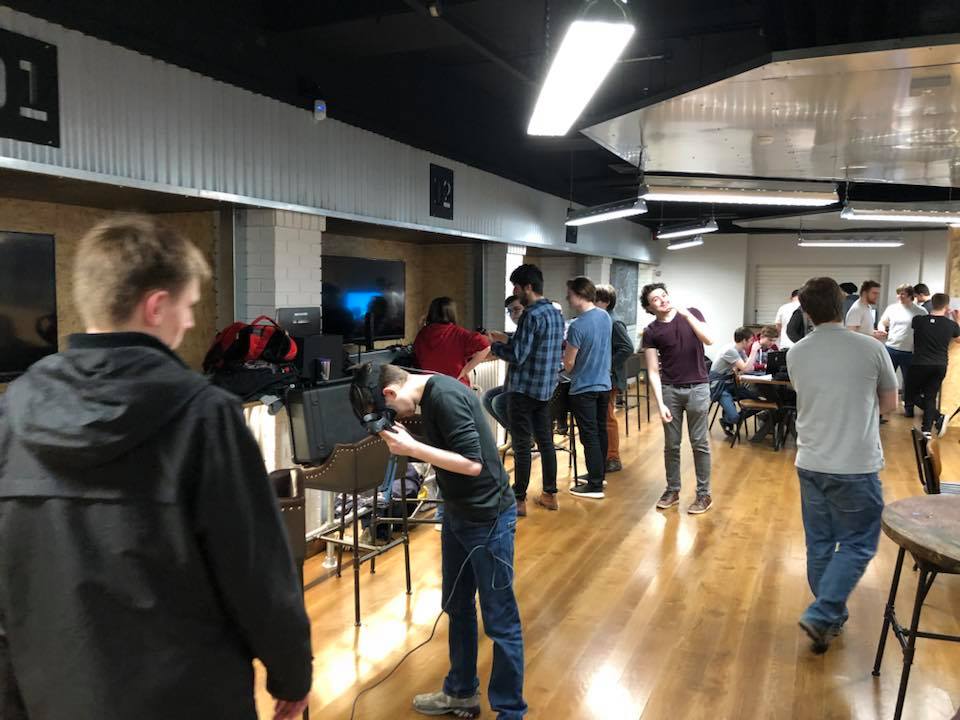
Our Group playtesting at the Pizza playtest event. (Courtesy of the UWE Games Technology page) [1]
Playtesting process
For this playtesting session we invited random members who were at the event to come and test our game. Whilst these individuals had not previously tested our game, every tester that we have interviewed has had experience with VR, either in development or playing VR games. So whilst the data is valuable, it must be said that it is limited in terms of informing us about individuals new to VR.
In the playtesting session we gave the player access to a room space and a HTC vive headset and allowed the said player to freely play around with our demo for a set amount of time. The player was given total freedom in the demo and was able to do whatever they wanted. After there said play session was over, the player was then interviewed to get there feedback on the experience and what they would like to see changed. In total we interviewed 5 individuals about the said demo.
The version of the experience that our players tested was that of commit 622816 which was published to the repository on April 7th 2018 and added a basic zoom feature.
Results of Playtesting
In terms of the concept that we were pitching, it received a positive response from a majority of those that were interviewed. Many of the interviewees remarked that the control scheme we were developing as part of the experience was very intuitive and easy to understand. Two of the individuals that we interviewed remarked at how the controls were quite similar to a smartphone, meaning for these individuals the control scheme was instantly recognisable and they were able to get to grips with the gestures really quickly and felt comfortable using the system. Similar remarks were echoed by other individuals who remarked at how the concept was a good idea.
However, many of the playtesters did observe issues with the system, namely the zoom function. Zooming was an issue for all of those that were interviewed with all of them remarking how the zoom was quite unstable and shaky. A solid majority of these testers remarked at how the zoom would either not respond at-all to subtle inputs or would be too responsive resulting in a shaky camera instead of the intended motion. Whilst the zoom was functional, many testers found it unusable with one tester also remarking how the zoom was imprecise.
Another issue that several testers found was related to the clamping of zoom and map movement. Some of the testers noticed that there wasn’t any clamping on the camera and as a result were able to do things such as zoom past the test assets we were using or move the camera of the said test asset and directly above the playspace. The testers were able to in essence move out of the designated play space with no issue or restriction. Hence many play testers did advise us to consider clamping the cameras position so we can’t exit bounds.
Additional Suggestions and Feedback
In addition to these findings we were offered a number of suggestions from the testers. One of the suggestions that we were given was the addition of haptic feedback to signal the player when they are controlling the map. The same individual who suggested this also mentioned how the map did obscure his vision a little bit and that resulted in motion sickness, but this view wasn’t echoed amongst the other testers.
Another suggestion we were given was the idea of having the height of the map very according to the height of the player, allowing it to accommodate for all sorts of people regardless of height. Whilst this individual did not highlight it as a serious issue in there feedback, they did feel such a feature would make the experience more accessible.
Conclusions and Response
Considering the feedback that we received we will be considering a number of changes to the application. The main issue that we will be addressing first will be the zoom which is clearly the feature that caused most concern with our testers. In response to these concerns our team will be looking into the zoom controls once again and we will look into both the addition of a clamp and a controller deadzone. Doing so should address both the sensitivity issues and the out of bounds issues in regards to the zoom.
For the positioning we will also consider having limits on the 2D axes as this will prevent players from being able to exit the bounds and should prevent this issue from arising again in further testing.
In regards to some of the suggestions we were given we are currently considering them as extra features and they will be considered, however it is more likely these said features will be added as so-called ‘quality of life features’ at the end of the development process. Also in regards to the motion sickness issue, the fact it was brought up indicates that more testing is needed in this aspect to see if there is a pattern to this issue of if it is an outlier of our sample. But whether it is an outlier or not we will be looking into how we can better prevent this.
Overall though it would seem we have an intuitive control scheme and whilst more playtesting is needed to see how the general public would respond, the feedback we got was positive and as such we will continue to peruse this as an avenue for controlling the system.